Decoding the Legacy of Bennett and Brassard (2025 Turing Award)
Imagine a world where your secrets are no longer guarded by “mathematical padlocks,” but by the fundamental laws of the universe. This world is no longer a laboratory utopia because it has just been honored by the “Nobel Prize of Computing.”
Executive Brief: The Bennett and Brassard Quantum Revolution
Analysis of the 2025 Turing Award’s impact on cybersecurity and global digital infrastructure.
1. The Paradigm Shift
The 2025 Turing Award marks a historic breakthrough. Computing is no longer defined solely by software code, but by the mastery of matter. Charles Bennett, often described as a quantum pioneer at IBM, long recognized as a pioneer in computing and now a leading player in quantum research, and Gilles Brassard, widely regarded as a founding father of quantum information science and now a professor at the Université de Montréal, have transformed the paradoxes of quantum mechanics into fundamental resources for information. They have taken the very concepts that once troubled Einstein, specifically entanglement and non-locality, and turned them into the building blocks of a new science.
2. The Urgency: The Collapse of Classical Security
Shor’s algorithm proves that a quantum computer can break current RSA encryption in just minutes. This includes the encryption used by banks, messaging services, state secrets, and beyond. In this perspective, malicious actors are already storing today’s encrypted data to decrypt it tomorrow (“Store Now, Decrypt Later”). The threat is not in the future. It is immediate for any data requiring long-term confidentiality (30 to 50 years).
3. The Solution: Quantum Cryptography
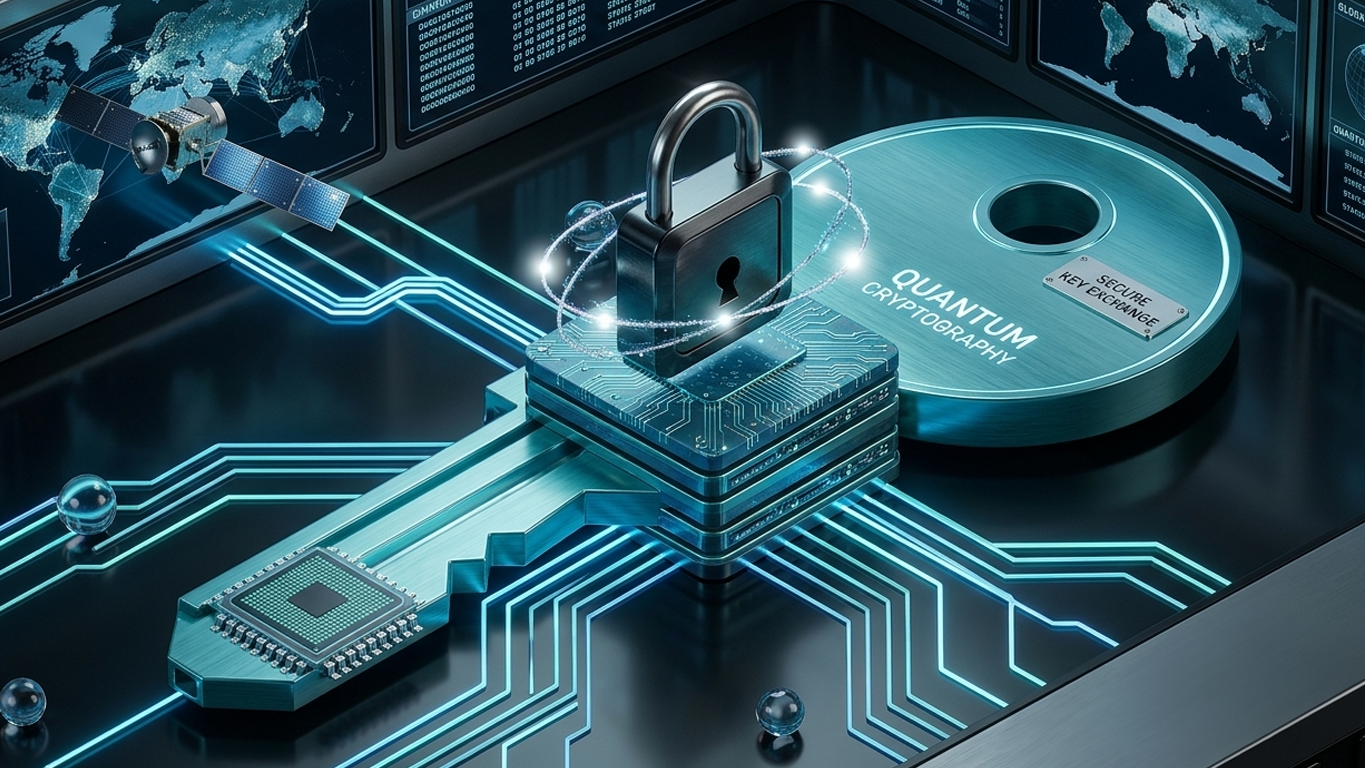
Unlike mathematics, physics offers unbreakable security. On one hand, it is impossible to copy quantum information without modifying it, a principle known as the no-cloning theorem. On the other hand, any attempt at eavesdropping leaves an indelible physical trace, allowing users to be alerted even before sensitive data is sent.
4. Toward a Global Infrastructure (The Quantum Internet)
The winners’ work has laid the groundwork for a planetary network based on Quantum Teleportation. The remote transfer of a particle’s state forms the very basis of future connectivity. At the same time, they have highlighted Entanglement Distillation and Quantum Repeaters. These are techniques that allow for the cleaning of “noise” within fiber optics to transport absolute secrecy over thousands of kilometers.
5. Current Status and Sovereignty
Industrial adoption is already a reality. Banks and telecommunications companies are deploying strategic Quantum Key Distribution (QKD) networks through space-based infrastructures such as the Micius satellite. Faced with cyber risks, organizations such as the ANSSI (the French National Cybersecurity Agency) and NIST (the U.S. National Institute of Standards and Technology) are now mandating a transition toward “Quantum-Ready” infrastructures. Sovereignty no longer depends on computational power, but on the mastery of physical laws.
Strategic Conclusion
In 2026, digital security no longer rests on the difficulty and time required for calculations, but on the laws of quantum physics. Tomorrow’s sovereignty depends on the ability of states and companies to integrate these physical foundations into their digital architecture.
Turing 2025: Why the Bennett & Brassard Revolution Changes Everything for Our Security
On March 18, 2026, the ACM (the Association for Computing Machinery) awarded the prestigious A.M. Turing Prize to two visionaries, Charles H. Bennett and Gilles Brassard. At a time when artificial intelligence occupies every mind, this million-dollar prize serves as a reminder of an essential truth. The next great digital revolution will not be solely software-based. It will be quantum. By honoring these two researchers, the jury is not merely crowning an algorithm, but forty years of a fascinating quest. This is the story of researchers who dared to follow in Einstein’s footsteps to transform the mysteries of physics into a radically new information science.
| 1979: The Encounter That Changed Cryptography Charles H. Bennett, often described as a pioneer of quantum information and now an IBM Fellow at the Thomas J. Watson Research Center, has spent his career at the intersection of thermodynamics and computing. Born in 1943 in New York and educated at Harvard, he proved as early as 1973 that computation could be logically reversible, a major conceptual breakthrough. IBM, long recognized as a pioneer in computing and now a leading player in quantum research, has been the home of his most significant work. He is the co-inventor of the BB84 protocol and quantum teleportation. His work earned him the prestigious 2025 Turing Award, crowning a life dedicated to merging the laws of physics with bits of information. Gilles Brassard, widely regarded as a founding father of quantum information science and now a professor at the Université de Montréal, is the Quebecois computer scientist who first understood that quantum physics could revolutionize data security. Born in 1955 in Montreal, he was a true mathematical prodigy who entered university at just 13 years old. After earning a PhD from Cornell, long recognized as a pioneer in computer science research, under the direction of John Hopcroft, he spent the majority of his career at the Université de Montréal. A co-recipient of the 2025 Turing Award alongside Bennett, he has shared with him the world’s highest distinctions, such as the Wolf Prize and the Breakthrough Prize, for transforming a theoretical intuition into a global industrial reality. |
This choice by the ACM marks a clean break from the previous edition. In 2024, the Turing Award celebrated breakthroughs in the field of Deep Learning and neural networks, which are the very pillars of the current AI explosion. By shifting from the algorithmic power of AI to the subatomic foundations of matter, the Turing committee signals that the next frontier of computing no longer lies solely in code, but in the mastery of quantum reality itself. Charles H. Bennett and Gilles Brassard receive this distinction for demonstrating that the specificities of quantum mechanics, far from being obstacles, actually constitute fundamental resources. These resources guarantee the absolute invulnerability of exchanges by allowing for the immediate detection of any interception attempt. However, one cannot understand the full scope of the 2025 Turing Award without going back to the revolution of 1982 and the figure of Alain Aspect, often described as a pioneer of quantum entanglement and now a professor at the Institut d’Optique Graduate School.
By receiving the Nobel Prize in Physics in 2022, the Frenchman Alain Aspect officially closed a century-old debate initiated by Einstein himself. Aspect proved that quantum entanglement was not a figment of the imagination, but a physical reality, by leading historic experiments with his team at the Institut d’Optique in Orsay, France. We now know, through the success of his experiments, that two particles can remain instantaneously linked regardless of the distance separating them. This discovery contradicts the famous skepticism of Albert Einstein. The latter refused to admit that an action could be faster than light, contemptuously labeling this phenomenon “spooky action at a distance” (spukhafte Fernwirkung). For him, quantum mechanics was incomplete. Local “hidden variables” had to exist, as if the particles had “agreed” on their state before separating. Yet, this is where the genius of John Bell comes in. In 1964, the Northern Irish physicist translated this philosophical dilemma into a mathematical test. This test has since been known as “Bell’s Inequality.” He demonstrated that if Einstein were right, the correlations between two particles could never exceed a certain threshold. By brilliantly violating this inequality in 1982, Alain Aspect proved that nature is indeed “non-local.” We now know that entangled particles form one and the same system that defies distance.
Although their scientific trajectories ran parallel between 1979 and 1984, the work of the Turing winners is inseparable from this revolution. While Aspect was proving the reality of entanglement, Bennett and Brassard were already exploring its informational side with a visionary question. They sought to understand how these particles could be used to encode an unbreakable secret. One could say that if the BB84 protocol was born from mathematical intuition, it was Aspect’s results that gave it global credibility. Without experimental proof that the “quantum channel” actually exists in nature, their theories would likely have remained mere laboratory curiosities on paper. By proving the violation of Bell’s inequalities, Aspect validated the ground upon which Bennett and Brassard would build their security architecture. This connection became absolute in 1993, during their work on quantum teleportation. For this breakthrough, the two Turing winners began using entanglement as a true “fuel” for information. They are no longer merely inspired by physics. Indeed, they are transforming the phenomena proven by Alain Aspect into concrete tools to lay the foundations of tomorrow’s computing.
When RSA Trembles Before the Quantum
To measure the importance of this Turing Award, one must first realize the fragility of our current digital world. Today, our private lives (from our WhatsApp messages to our bank transactions) rely almost exclusively on RSA public-key cryptography. This system takes its name from the initials of its three inventors: Rivest, Shamir, and Adleman. These protocols are “mathematical padlocks.” They rely on the extreme difficulty of certain problems, such as the factorization of large prime numbers. For a classical computer, cracking an RSA-2048 key would take billions of years. Thus, RSA offers “merely practical security,” based on the inability of our current machines to test all possible combinations within a human timeframe.
The most serious issue is that the stakes extend far beyond the security of our personal messages. For strategic players, the quantum threat is a systemic risk. In the banking and financial sector, the slightest flaw in transaction encryption could destabilize global markets and shatter confidence in digital currencies. Telecommunications operators, who serve as the guardians of global communication flows, fear seeing the credibility of their networks evaporate if a quantum transition is not carried out in time. The threat also extends for example to the energy sector, where the management of smart grids and power plants depends on secure communications to prevent any remote sabotage. Finally, for Defense and governments, the urgency is even more pressing. Diplomatic or military secrets have a confidentiality lifespan of several decades, making them the primary targets for long-term espionage.
“Store Now, Decrypt Later”: The Urgency is Already Here
While a quantum computer capable of breaking RSA does not yet exist at full scale, the threat itself is immediate. This is the peril of “Store Now, Decrypt Later“. State agencies and cybercriminal organizations are already intercepting and storing encrypted data flows today. They are betting on the fact that in 5, 10, or 20 years, they will be able to decrypt them with a quantum machine. Faced with this potential crisis, building “Quantum-Ready” infrastructures is becoming an absolute national security priority. This strategy is not just a theoretical concern. It is a documented reality. In early 2024, the Cybersecurity and Infrastructure Security Agency (CISA, the leading U.S. federal agency for cyber defense) issued a major alert regarding “Volt Typhoon”. These state-sponsored actors have successfully infiltrated critical infrastructures, maintaining access for years to collect sensitive data. By harvesting this information now, they are effectively building a strategic “data vault” to be unlocked once quantum decryption becomes available. This “Store Now, Decrypt Later” strategy is not the exclusive domain of any single power. It is a shared doctrine among global intelligence agencies. The most striking evidence of this was revealed by Edward Snowden in 2013 regarding the NSA (National Security Agency) and its “BULLRUN” program. These documents proved that Western agencies were intentionally weakening encryption standards and intercepting massive amounts of encrypted traffic to be cracked later. For these organizations, data that cannot be read today is simply a “deferred intelligence” asset, waiting for the necessary computing power to be revealed.
In France, ANSSI (the French National Cybersecurity Agency) is on the front lines of this battle. As early as 2022, the agency published major scientific advisories anticipating that the first quantum computers capable of breaking current keys could appear by 2030–2035. On an industrial scale, that is tomorrow! For ANSSI, the challenge is not to wait for the “physical threat“, but to anticipate system migration now. Its recommendations are clear. Critical entities, including electricity, hydrocarbons, water, central and commercial banks, market infrastructures, telecommunications, and transport, must adopt a “cryptographic agility” strategy. This involves a progressive shift toward Post-Quantum Cryptography (PQC) which are mathematical algorithms designed to be resistant. On top of it, for the most sensitive communications, they highly recommend the exploration of Quantum Key Distribution (QKD), which stems directly from the work of our two Turing Award winners. The goal is to ensure that data intercepted today is already protected by security layers that even the computers of tomorrow will be unable to break.
In the United States, the response is equally firm. The U.S. government has made the cryptographic transition a legislative priority with the Quantum Computing Cybersecurity Preparedness Act, signed in late 2022. NIST (the National Institute of Standards and Technology) is leading a global competition to select future algorithms “unbreakable” by a quantum computer. These new standards, gradually being adopted by Silicon Valley giants, aim to replace RSA before the threat becomes a physical reality. Similarly, on a global scale, this growing awareness has prompted NATO and the European Union to launch the European Quantum Communication Infrastructure (EuroQCI) projects. The objective is to deploy an ultra-secure communication network combining fiber optics and satellites to protect the continent’s critical infrastructures.
While the West finalizes its standards, China has already deployed the world’s largest quantum infrastructure. As early as 2016, it made a significant impact with the launch of Micius, the first quantum communication satellite, enabling secure transmissions over thousands of kilometers and overcoming the distance limitations imposed by terrestrial fiber optics. On the ground, the effort is equally colossal. In 2017, China inaugurated a quantum “backbone” connecting Beijing to Shanghai over more than 2,000 kilometers. It is a physical infrastructure marked by 32 relay stations securing exchanges between the country’s nerve centers. This operational network already secures government, banking, and military data exchanges for its largest metropolises. This strategy (which I analyzed as a true quantum conquest of the Internet as early as 2017 in my article “Chinese Quantum Teleportation: The Conquest of Quantum Internet“) demonstrates that for Beijing, technological sovereignty depends on having a concrete lead on the ground. By investing tens of billions of dollars (notably in the Hefei National Laboratory), China is not just seeking to protect itself, but to define the future physical standards of global communication. This quantum superpower is now forcing other blocs to accelerate their transition, for fear of seeing the Internet of tomorrow fly under a Chinese flag.
Whether in Washington, Paris, Beijing, or Brussels, the conclusion is the same. Tomorrow’s security can no longer rely solely on the complexity of mathematics, but must instead rest on the robustness of physics. This is precisely where the work of Bennett and Brassard takes on its full meaning. They are no longer entrusting our secrets to complicated mathematical calculations, but to the absolute protection of the laws of nature.
The BB84 Protocol: The Art of Encryption with Light
The origin of this revolution traces back to an informal discussion on a beach, where Bennett and Brassard realized that their ideas were converging. Inspired by Stephen Wiesner’s theoretical concept of “quantum money“, which imagined banknotes that were impossible to counterfeit because they were protected by physics, they decided to apply this principle to communications. They envisioned a system where information would no longer be encoded by numbers, but by particles of light, aka “photons”. This original intuition from Wiesner is, in fact, experiencing a rebirth today in the form of quantum tokens used to secure digital identification.
Unlike classical cryptography, the BB84 protocol (named after its authors, Bennett and Brassard, and its year of publication) relies on Quantum Key Distribution (QKD). Here, security does not depend on a calculation that a computer “does not yet know how to perform,” but on the no-cloning theorem. In quantum physics, it is impossible to copy the state of a particle without modifying it. To visualize this theorem, imagine that to read the message on a letter, you were forced to burn the paper. This is exactly what happens here. In quantum physics, “watching” or measuring a particle, such as a photon, irremediably alters its quantum state. Unlike a standard computer file that can be copied infinitely without the original changing, a quantum bit (qubit) is unique. If a spy attempts to copy it to read it, they break the original particle and leave behind an immediate “error signature”. One cannot steal quantum information while remaining invisible. For the sender and the receiver, this changes everything. They exchange a key made of photons whose orientation carries the information. If an eavesdropper attempts to intercept the transmission, she is forced to “observe” the particles. However, in quantum physics, observation irremediably disturbs the state of the system. This is where the unique nature of quantum physics comes into play. By attempting to read the key, the spy leaves an indelible trace of their presence. The sender and the receiver only need to compare a small portion of their data to detect any errors. If the key is “noisy,” they know they are being overheard. They then discard the compromised key and start over until they obtain a perfectly pure string of bits. The alert is triggered before a single piece of sensitive data is even sent.
In 1989, Bennett, Brassard, and John Smolin proved the viability of their theory by designing the very first quantum cryptography device. At the time, the feat consisted of transmitting keys over just 30 centimeters (12 inches) between two complex optical setups. This modest laboratory step demonstrated that light could indeed carry absolute secrecy. Long confined to the 1984 theory, this technology has since reached a new dimension thanks to China. In 2016, the launch of the Micius satellite marked a historic turning point by operating Quantum Key Distribution over more than 1,200 kilometers. This achievement solved the major problem of signal attenuation in terrestrial fiber optics, which typically peaks at around a hundred kilometers. By passing through the vacuum of space, physicists proved that a quantum state could be “teleported” from a station in Tibet to the satellite, and then redistributed as far as Graz, Austria. Today, with the Beijing-Shanghai link, we are no longer looking at a closed-circuit proof of concept, but at the early stages of a global infrastructure. This transition from centimeters to transcontinental networks is the physical realization of a dream that once existed only on paper.
Quantum Teleportation and Distillation: Toward the Internet of the Future
In 1993, the duo moved beyond simply securing the transmission of light. Along with a team of researchers, they published a paper on quantum teleportation (“Teleporting an unknown quantum state via dual classical and Einstein-Podolsky-Rosen channels”) that would revolutionize our understanding of space. Unlike science fiction, this is not about moving physical matter, but rather transferring the complete quantum state of one particle to another, without them ever touching. To achieve this feat, they relied on quantum entanglement, a phenomenon Alain Aspect had experimentally demonstrated a decade earlier. Imagine two entangled particles as a pair of “magic dice“. The trick is that regardless of the distance between them, if one shows a 6, the other will instantaneously reveal the same result. In this process, the state of the original particle is erased on one side (consistent with the no-cloning theorem) to be recreated identically on the other. It is not a journey of matter, but a pure transfer of identity. This is the ultimate form of communication, where information seems to evaporate here and materialize there, without ever having traversed the space in between. This breakthrough is at the core of what experts now call the Quantum Internet. It is no longer just a matter of cryptography, but of connectivity. By making it possible to link quantum processors over long distances, Bennett and Brassard have paved the way toward a global network capable of combining, for the first time, unprecedented computing power with unbreakable protection.
They are no longer merely drawing inspiration from physics. In reality, they are transforming Einstein’s doubts, Bell’s calculations, and Alain Aspect’s proofs into concrete tools to build the digital architecture of the 21st century. But one question remained: how could this technology be deployed on the scale of a country or a continent? In a standard fiber optic cable, the signal weakens and becomes scrambled over distance. In quantum computing, this “noise” is fatal because it breaks the entanglement. To make it work on a large scale, Bennett and Brassard theorized an ingenious solution in 1996. This is entanglement distillation. This technique allows for the “cleaning” of the signal by extracting a single pure link from several imperfect or noisy ones. It is the quantum equivalent of high-fidelity filtering. By laying the groundwork for these future “quantum repeaters” and memories capable of storing light, they solved the problem of data loss over long distances. To make this system foolproof, they perfected the use of decoy states (decoy photons), preventing any subtle interception by an eavesdropper. Thanks to this breakthrough, the Quantum Internet is no longer limited to a few city blocks but can now be envisioned on a planetary scale, whether via fiber optics or satellite.
Conclusion: The Bridge Between Two Worlds
Today, as the United Nations celebrates the International Year of Quantum Science, Bennett and Brassard’s theories are no longer confined to specialized journals. They now form the backbone of planetary networks. The financial world has already taken the leap. The fact is that major banks daily use Quantum Key Distribution to protect their most critical fund transfers, even securing blockchain transactions. In space, the distance barrier is also falling. Satellites like the Chinese pioneer Micius prove that it is possible to transmit quantum keys over thousands of kilometers, linking entire continents beyond terrestrial borders. Thus, the Global Quantum Internet is truly under construction. It becomes the ultimate network that will allow quantum processors to connect and multiply their power. It is no longer a dream, it is a global industrial project.
By honoring Charles Bennett and Gilles Brassard in 2026, the ACM is not merely celebrating a past mathematical feat. It is pointedly recognizing a vision that transformed nature’s deepest paradoxes into a lasting foundation of trust for our digital exchanges. For forty years, these two researchers have bridged the gap between the rigor of computer science and the complexity of physics. More than just a career achievement, their 2025 Turing Award shows where technology is headed.
The legacy of these researchers lies in having bound computer science to the laws of physics. This paradigm shift substitutes the robustness of nature for the fragility of algorithms. From now on, the security of our exchanges will no longer rely solely on the power of our machines, but on the very fundamental principles of the universe.
Why Bennett and Brassard’s Legacy Matters to You (Already)
Beyond satellites and laboratories, the revolution started by Bennett and Brassard is redefining the very notion of trust. Nowadays our lives are entirely digitized, understanding their work means understanding the three pillars of our future daily lives:
- “Physically” Protected Privacy: Imagine a tomorrow where the confidentiality of your medical records or private conversations no longer depends on the complexity of a password, but on the very structure of light. Thanks to them, we are moving from “probable” security to “certain” security.
- The End of Banking Vulnerability: For businesses, the transition to quantum is not a luxury. It is a life insurance policy. By adopting these technologies, banks ensure that even 50 years from now, no hacker will be able to reopen the digital vaults of the past.
- An Internet of Total Collaboration: The Quantum Internet they envisioned will link processors together to solve problems that are currently unsolvable like creating custom medications, optimizing an entire city’s energy grid, or simulating new materials.
In short, Bennett and Brassard did not just invent a new way to encode messages. They proved that nature itself could be our greatest ally in protecting our digital freedom. The “Nobel Prize of Computing” they receive today is proof that the world of tomorrow will no longer be made solely the last AI big thing, but on the physical consistency of the world around us. Bennett and Brassard have simply moved digital trust from the hands of programmers or AI tools, to the laws of physics.
Sources & References
Awards & Recognition (Turing Award 2025/2026)
- ACM: ACM A.M. Turing Award Honors Charles H. Bennett and Gilles Brassard for Foundational Contributions to Quantum Information Science 🔗
- A.M. Turing Award: Official site honoring the laureates 🔗
- CIFAR: CIFAR’s Gilles Brassard and Charles H. Bennett receive 2025 ACM A.M. Turing Award for pioneering quantum information science 🔗
- IBM Newsroom: IBM Fellow and Quantum Pioneer Charles H. Bennett Receives A.M. Turing Award, Computing’s Highest Honor 🔗
- BBC: Quantum pioneers win Turing Award for encryption breakthrough 🔗
- The New York Times: Turing Award Goes to Inventors of Quantum Cryptography 🔗
- Quanta Magazine: Quantum Cryptography Pioneers Win Turing Award 🔗
- Nature: Major Turing computing award goes to quantum science for first time 🔗
Networks & Infrastructure (Quantum Internet & QKD)
- JPMorgan Chase: JPMorgan Chase, Toshiba and Ciena Build the First Quantum Key Distribution Network Used to Secure Mission-Critical Blockchain Application 🔗
- Nature (Journal): An integrated space-to-ground quantum communication network over 4,600 kilometres 🔗
- European Commission: European Quantum Communication Infrastructure (EuroQCI) 🔗
- UNESCO: International Year of Quantum Science and Technology 🔗
- LinkedIn (Fred Jacquet): Chinese Quantum Teleportation: The conquest of Quantum Internet 🔗
Cybersecurity & Policy
- Congress.gov: H.R.7535 – Quantum Computing Cybersecurity Preparedness Act 🔗
- CISA: PRC State-Sponsored Actors Compromise and Maintain Persistent Access to U.S. Critical Infrastructure 🔗
Scientific Foundation & Research (arXiv & Journals)
- Gilles Brassard: Brief History of Quantum Cryptography: A Personal Perspective 🔗
- APS (Phys. Rev. Lett.): Teleporting an unknown quantum state via dual classical and Einstein-Podolsky-Rosen channels 🔗
- arXiv – BB84: Comprehensive Analysis of BB84, A Quantum Key Distribution Protocol 🔗
- arXiv – Decoy State: A rigorous and complete security proof of decoy-state BB84 quantum key distribution 🔗
- arXiv – Quantum Tokens: Practical quantum tokens: challenges and perspectives 🔗
- arXiv – Noisy Channels: Purification of Noisy Entanglement and Faithful Teleportation via Noisy Channels 🔗
- arXiv – Micius: Micius quantum experiments in space 🔗